There are some lessons that only the field can teach you.
In 1996, I was a young engineer working across the then-vast Tororo District, long before Busia and Butaleja became separate districts and before parts of the present-day Mbale administrative landscape took shape.
My workplace was not an air-conditioned office. It was the road.
Mulanda. Butaleja. Mukuju. Kwapa. Merikit. Nagongera. Busiwu. Manafwa. Nagongela. Lubongi.
For two years, I travelled those communities in a 1972 Land Rover without doors, carrying a notebook, drilling equipment and a resistivity machine. There was no Facebook. No WhatsApp. No social-media court of public opinion.
There were rocks to interpret, boreholes to sink, drilling logs to maintain and communities waiting for water.
The rig followed behind. Dust entered through every opening. Rain entered too. The wind hit your chest as you drove. The notebook rested on your lap.
That was engineering in the field.
And that is why, when I now see engineers being casually accused of corruption on social media whenever a borehole fails, I become deeply concerned.
Not because engineers should never be questioned.
They should.
But because a failed borehole is not automatically evidence of corruption.
A borehole is a technical undertaking involving geology, hydrogeology, geophysics, drilling, construction, testing, water quality and pumping systems.
Let me explain it the way Jjaajja Eng. Livingstone Naidoo once explained such things to me and Nakintu around the fire at Ku Musanvu.
TORORO TAUGHT ME THAT WATER IS ALSO ABOUT PEOPLE
Before talking about rocks, pipes and pumping tests, I must acknowledge the people who made fieldwork memorable.
Eastern Uganda fed us well.
I remember Gweno, Mbaata and Atapa.
When the drilling team arrived, the local RC chairmen would mobilise the community.
“Engineer has come!”
Before the toolbox was opened, there could be a basin of hot water, food beneath a mango tree and conversation with the community.
Gweno from the village. Mbaata fried with salt. Atapa—the firm millet bread capable of carrying you through an entire day of fieldwork and pumping tests.
It was more than food.
It was hospitality.
It was a community saying: water matters, and the people working to find it are our guests.
In Mulanda, I also remember the beautiful home of the late Oboth Ofumbi. The compound was immaculate, the flowers carefully arranged and the bricks properly fired.
His daughter later became my secretary during those two years in Tororo. She was sharp, disciplined and meticulous, maintaining our drilling records and typing VES information on a manual typewriter while I stood outside in the sun, calling out figures with the doorless Land Rover parked nearby.
Those memories remain because field engineering was never only about machinery.
It was about people.
THE FIRST MISTAKE: ASSUMING WATER IS EVERYWHERE
One of the biggest misconceptions about boreholes is simple:
Drill anywhere and you will find water.
No.
Groundwater does not simply sit beneath every piece of land waiting for a drill bit.
In many parts of Uganda, groundwater is stored and transmitted through particular geological formations, including weathered and fractured rocks.
Think of two broad underground zones.
The first is the weathered zone, where rock has broken down and become softer. It may store and transmit groundwater.
The second is the deeper hard-rock environment, where groundwater can occur within fractures and joints.
Drill into favourable geology and you may strike water.
Drill into massive, unfractured rock and you may find very little.
Drill into unsuitable clay and you may have an expensive hole with disappointing results.
That is why hydrogeological investigation matters.
THE MACHINE THAT LISTENS TO THE ROCKS
This is where the resistivity survey comes in.
Before drilling, a geophysicist or hydrogeologist can investigate the subsurface using electrical resistivity methods.
Electrodes are placed in the ground and an electrical current is introduced. Different geological materials respond differently to the current.
The resulting measurements help create an interpretation of what lies beneath the surface.
The objective is not to produce magic.
It is to reduce uncertainty.
The survey helps identify geological structures and zones that may have a higher probability of containing groundwater.
That distinction is important.
A geophysical survey does not guarantee water. It improves the basis on which a drilling decision is made.
That is precisely why drilling without adequate investigation can become a gamble with public money.
During my professional journey, I encountered approaches to groundwater development in countries such as Zimbabwe and Zambia, where groundwater and irrigation expertise had developed significantly. Institutions such as RUWASA also played a role in building local technical capacity.
The lesson was straightforward:
You do not fight geology with politics.
You study it.
A DRILLING RIG IS NOT A WHEELBARROW
A drilling operation is expensive.
Bits, drill rods, compressors, fuel, casing, transportation, labour and specialist equipment all carry substantial costs.
The figures vary depending on equipment, location, depth, geological conditions and contract specifications, but anyone who has worked around a drilling rig knows that this is serious capital equipment.
A compressor consuming hundreds of litres of diesel in a working day is not a casual expense.
A rig worth hundreds of thousands of dollars is certainly not brought to a village for entertainment.
This is why every metre drilled should mean something.
The drilling team records geological formations encountered at different depths.
That log is not paperwork for the sake of paperwork.
It is the story of what the drill actually found.
A BOREHOLE IS ENGINEERED — IT IS NOT SIMPLY A HOLE
This is another point that deserves public understanding.
Drilling a hole is only one part of constructing a borehole.
The final installation must be designed around the geological information obtained during drilling.
There may be sections requiring solid casing and other sections requiring appropriately designed screens.
The screen allows groundwater to enter while limiting the entry of formation material.
Around the screened section, a properly selected and placed gravel pack can provide filtration and stabilisation.
The upper section requires appropriate sanitary protection, including a properly constructed seal, to reduce the possibility of contaminated surface water entering the borehole.
Every component has a purpose.
The casing has a purpose.
The screen has a purpose.
The gravel pack has a purpose.
The sanitary seal has a purpose.
The apron and drainage arrangements at the surface have a purpose.
Remove one part of the engineering and the entire system can suffer.
That is why a borehole that produces water is not necessarily a properly constructed borehole.
THE PUMP TEST IS WHERE THE TRUTH EMERGES
After drilling and development, you still have another critical stage.
Testing.
The borehole has to be developed so that drilling debris and fine particles are removed as far as practicable.
Then comes pumping.
The response of the water level under pumping tells the technical team important things about the borehole’s performance.
How quickly does the water level fall?
How much water can the borehole sustainably produce?
What happens when pumping stops?
How quickly does the water level recover?
These are not political questions.
They are technical questions.
A borehole producing a small yield cannot simply be fitted with a huge pump and ordered to supply a large institution.
That is how you turn a technical problem into a mechanical one.
The pump must correspond to the borehole’s sustainable yield and the requirements of the water system.
I remember occasions in Mulanda when boreholes with inadequate yields were sealed rather than presented as successful projects.
That is what professional responsibility sometimes looks like.
The most important word an engineer can say is not always “yes.” Sometimes it is “no.”
THEN COMES THE WATER ITSELF
Finding water underground is not the end.
The water must be tested.
What is its chemical composition?
Is there excessive iron?
Are there other minerals of concern?
Is it bacteriologically safe?
Does it meet the intended use?
A borehole supplying a community is not merely a hole that produces liquid.
It is a water source.
Therefore, water quality matters just as much as water quantity.
FROM THE AQUIFER TO THE JERRYCAN
The engineering does not stop at the borehole.
Suppose water is found at approximately 35 metres, the storage tank is elevated, the community is situated on higher ground and the distribution network introduces additional friction losses.
The pump has to overcome the combined hydraulic requirements.
That is where concepts such as total dynamic head become important.
The pump must be selected according to the borehole yield, required flow, head and system characteristics.
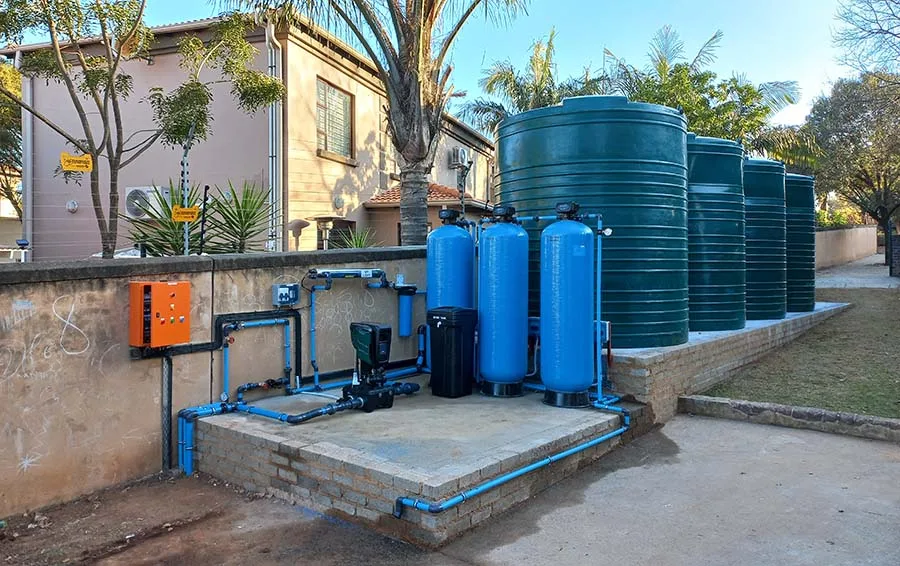
A hand pump is not the same engineering solution as a solar-powered pumping system feeding an elevated storage tank.
The tank must be properly designed.
The pipeline must be appropriately installed.
The water point needs proper drainage and sanitary protection.
So remember the chain:
The survey investigates it.
The drill reaches it.
The construction protects it.
The gravel pack filters it.
The test measures it.
The pump lifts it.
The tank stores it.
The pipeline carries it.
The tap delivers it.
Remove a critical link and the system can fail.
WHERE ARE THE PROFESSIONAL BODIES?
This is where my concern becomes broader.
Where are the professional engineering institutions when technical issues become social-media controversies?
Where are the regulators?
Where are the geologists and hydrogeologists?
Where is the professional voice explaining to the public what actually happens before a borehole is commissioned?
I would particularly like institutions such as the Uganda Institution of Professional Engineers (UIPE), the Engineers Registration Board (ERB) and relevant professional bodies to engage more aggressively in public technical education.
Not through complicated conference papers.
Through simple language.
Tell the public what documents should exist around a properly managed borehole project.
For example:
The hydrogeological/geophysical investigation report.
The drilling log.
The borehole construction record.
The pumping or aquifer test results.
The water-quality laboratory report.
The public deserves to understand these documents.
PROTECT THE ENGINEER WHO TELLS THE TRUTH
There is another issue we must confront.
What happens to the young district water officer who tells a powerful local leader:
“This is not the right site.”
What happens when the officer says:
“The geological evidence does not support drilling here.”
Or:
“The borehole yield is inadequate.”
Or:
“The latrine is too close to the proposed water source.”
If every technical disagreement becomes an accusation of corruption, we will eventually create a dangerous culture.
Engineers will become afraid to disagree.
Technicians will begin following political instructions rather than technical evidence.
And communities will ultimately pay the price.
Professional bodies should protect legitimate technical independence while also holding their members accountable when professional standards are breached.
If an engineer genuinely falsifies records, compromises construction standards or manipulates test results, there must be appropriate professional and regulatory action.
Accountability and professional protection are not opposites.
They are two sides of the same system.
TO THOSE TURNING BOREHOLES INTO SOCIAL-MEDIA BATTLES
To those making accusations around failed boreholes, I say this:
Ask questions.
Demand accountability.
But ask technical questions before making technical accusations.
Where is the survey?
Where is the drilling log?
Where is the construction record?
Where is the pumping test?
Where is the water-quality report?
If those documents exist, examine them.
If they do not exist, ask why.
If the work was poorly executed, establish what went wrong.
If the geology simply failed to provide the expected yield, understand that too.
A dry or low-yield borehole is a problem to be investigated—not automatically a crime to be announced on Facebook.
ENGINEERS MUST ALSO LEAVE THE OFFICE
But the responsibility does not belong only to the public.
Professional institutions must communicate.
Engineers cannot retreat into technical language while misinformation spreads outside their offices.
Take the message to radio.
Take it to communities.
Take it to local leaders.
Explain in Luganda.
“Amazzi tegali buli wamu; gali mu lwazi.”
Water is not necessarily everywhere. Its occurrence depends on the geology beneath our feet.
That single sentence can educate more people than a hundred technical presentations delivered to people who already understand the subject.
A FINAL WORD FROM THE TORORO OF 1996
When I look back at those two years, I remember the dust.
I remember the rain.
I remember the doorless Land Rover.
I remember the notebook on my lap and the drilling rig behind me.
I remember the resistivity machine and the long hours trying to understand what the rocks beneath our feet were saying.
And I remember the people of Tororo.
The Gweno.
The Mbaata.
The Atapa.
The mango trees under which engineers and villagers sat together.
That generation understood something we sometimes forget today:
Water is too important to be reduced to political noise.
Question engineers.
Question contractors.
Question government.
Question professional bodies.
Demand value for public money.
But let the questions be informed by science.
Because beneath every borehole is a geological story.
And if we do not understand that story, we risk confusing technical failure with corruption, professional disagreement with misconduct, and scientific evidence with politics.
The young engineer standing in the dust deserves the freedom to say, “This site will not work.”
The community deserves clean, reliable water.
The taxpayer deserves accountability.
And the profession deserves the courage to defend both science and integrity.
That is the lesson I carried from Tororo in 1996—and the notebook, in spirit, is still in my pocket.